


Hunting overkills this Fall
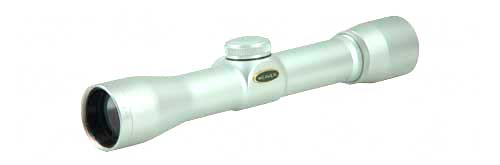 For most of the Northeast, hunting will start in about 6 weeks for archery and then small game begins. Archery has gained a lot of ground in this region because so much of the good hunting areas are populated and it’s hard to safely manage deer populations if areas where it’s not really safe to use a firearm. I still don’t know why so many people go with monsterous optics that when put under any kind of realistic hunting test, will always slow you down. Whenever I ask people what they are doing with a 50mm objective on a gun that is really meant for something that weights 800lbs and they are out hunting white tail, they usually say they are afraid of making bad shots.
From my own personal experience in the military and law enforcement community, I think hunting with a red dot is probable more practical than any optic that magnifies more than 5xs. For small game I’d recommend against using a red dot, but there have been times I’ve been tempted to just bring a Mini 14 with an Eotech out for while tails just because the speed I get with that configuration is better than any lever action or 7mm bolt action. Whenever you are thinking about doing long range shooting, go ahead with magnification, but wheneve you are thinking about rifle scopes for hunting applications, do a realistic gauge of how good your eyes are and what kind of opportunities you may expect when out in the field, and don’t slow yourself down with too much magnification or an optic that has an eye relief inhibits your mobility.
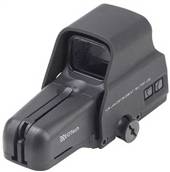 The Trijicon NSN has iron sights mounted on the top of the rifle scope which can come in handy in closer situations and are a less expensive alternative to mounted a red dot on your ACOG. That is worth the money if you are in the line of work that calls for it, but for general blasting and plinky, I think that $1800 optics is a bit much. The Eotech 512 is probable my recommended optic for an M4. I think people can get carried away with optics on the M4 because even though the rifle is pretty accurate, it really is not very powerful or effective past 200yds. With a growing selection of combat optics you can put on the AR15 type rifles, one other suggestion I have for shooters is to always keep your iron sights on the rifle. I’ve seen a few people show up at classes with just an Eotech mounted and they complained the front sight blocked their FOV. Well, taking a 200yd shot with an Eotech that has a dead battery is like parking a mini van from the furthest back seat.
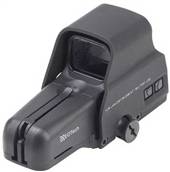 Like many tactical shooting accessories, you have to put a lot of thought into which type of configuration you want on your Carbine before you spend the money or you will find out real fast you just spent $500 on some thing that you really didn’t need. The differences between using some of the fixed power Trijicon rifle scopes, Leupold CQT, and the Eotech 512 are considerable. Each can be used for many things with an advanced shooter, but they are intended for certain applications and within those boundaries, they work well. There was a shift away from the Trijicon ACOG for some military and law enforcement personel because once we invaded Iraq, and the house to house fighting went on for several years, the need for magnification was virtually unnecessary.
 I remember the days when I would stare at rifle scopes and ask shooters how much they cost, and when they told me how the rifle scopes cost, I’d calculate that whichever rifle I was thinking about putting the scope on, the cost of the rifle was less than the cost of the optic. I have no idea how much money companies are making off of some optics, but there is a certain point that I really don’t care how good people think they are, 90% of people spending that kind of money on optics probable could get the job done with something that cost 50%-75% less. In all of my years of target shooting and plinking, I have only had scope mount issues and 2 rifle scopes that ever broke. Every rifle scope that broke cost less than $100. I have a few Leupolds that have been on bolt actions and semi-autos and they all hold zero and have excellent clarity.
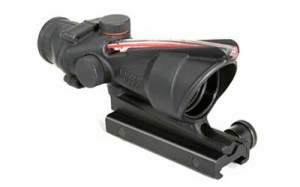 It seems that the M4 AR15 variant is hands down the most popular carbine in existance in the United States. There are plenty of AK and European military style rifles out there, but the accessorized M4 is king. When I first stepped into the high speed tactical carbine school, I was going there from previously owning only Kalashnikov variant rifles. The biggest promotion I heard from all of those owning an AR15 was how accurate they were. It is true that the M4 and AR15 family of rifles ARE the most accurate combat rifles, but that doesn’t make them the most effective. Ever since the Iraq invasion, the notion of just sending in a group of guys with M4 Carbines or M16s without a 7.62 DMR is not common. There was a lot of hype about the military digging up M14s and giving them this role, but now that several years have passed, the military has been working with newer models of 7.62 rifles to eventually fill that role.
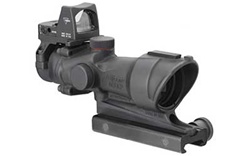 It’s always up to the operator to determine which configuration works best for him, but with the reliance on battery operatored optics and high mounted optics, it’s really a good idea for a user to consider the what ifs. What do you do with your Eotech if the batteries die? What happens if the optics come loose ? Scope mounts can come loose and even break, I’ve seen this happen on M1A rifles, AK, FAL and AR15s on several ocassions. Sometimes its a good idea to train yourself to be able to hit a target without even a rear sight. There have been several times where I actually forgot to flip up my rear sights on my co-witness configuration and just used the sight picture from my Eotech optic and the front sight post. I never missed what I was aiming at and it was actually good practice for me.
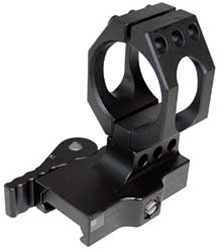 Another issue you may run into when using hunting style optics on a military style rifle is this. What are you going to do if the optic fails or breaks? Are you going to need to u se a screw driver to remove it or can you detach it quickly? Quick detach optics and accessories can become very important if you have a failure of some sort. For instance, I’ve seen plenty of incidences where soldiers in Iraq took bullets in their optics but the rifles still worked. Always have backup irons on an M4 is a good idea. Not only can batteries on something like a Eotech gun sight go down, but sometimes that can actually get broken from being slammed around or from fragmentation. The Mini 14 ranch rifle is a very manueverable Carbine. Even though the Eotech optic is primarily for military purposes, I’ve found the Eotech to work very well on a Mini 14 Ranch rifle. The MOA dot works well with a gun that can shoot MOA as long as the rifle barrel has not heated up, which normally occurs after the 3rd shot, but from a hunting standpoint, I rarely know anyone that takes 3 shots on any hunting trip.
 There is a point where people have to learn to realize that there are a great many firearms manufacturers out there that are making suberb firearms. I’ve heard people claim that a certain firearm was superior in reliability over another. Well, that is true to some degree, but I’d have to say there are some firearms that are in the top tier category and the durability and reliablity differences may vary in extreme circumstances. Take a Glock 17 and put it up against a Sig 226 and you’ll see what I mean. I’m sure the Glock will reguire less lubrication, but there won’t be much difference in 98% of circumstances.
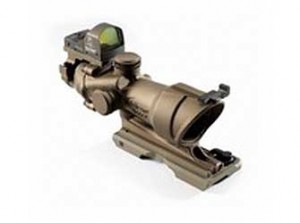 One problem that any hunter already knew was using too much magnification meant slow target acquisition, especially at close ranges. Field of view is even more important in combat than in hunting. In Combat you may be looking at a bad guys face with your reticle right on him, but 6ft to his right is a guy with his sights right on you that you can’t see. I’d have to say that I belive that 3x-4x is probable the best of both worlds. Trijicon knew that even an optic with zero magnification like the Eotech had an edge in some situations so now they have Trijicon ECOS which has a red dot optic which sits on top of the scope. This will eliminate the problem of magnification in close quarters situations.
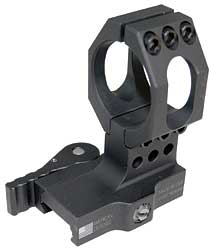 Adding the extra security may mean that your scope won’t come loose after a few thousand rounds. I’ve seen guys with battle rifles with $1000 optics on them and after a few thousand rounds, the mounts came loose. None of these individuals were using loctite. Over torquing screws is something to be concerned about because screwing a mount in as tight as you possible can does not mean more security, it actually means more stress. Loctite doesn’t add stress to your gun mount it just helps keep the grip on your screws so they don’t rotate after long firing periods.